Tips for navigating a bike ride when kids are biking and their caregivers are walking.
We live in Boston and while I absolutely want my kids to embrace the bicycle as a tool for joy, adventure and transportation, I’m also very focused on how I keep them safe. Once they transitioned from balance bikes to pedals (with balance bikes it was fairly easy to keep up and walk besides them, but with pedals they’re always in front of me), I really thought about what I could do to help stay safe. This post will cover visibility and behavior strategies for when kids are biking and their caregivers are on foot.
Helmets
This is the most basic, but a well fitting helmet is super important. Like carseats, helmets all have to meet certain guidelines for safety. Just because a helmet is more expensive, doesn’t mean it is safer.
Helmets have (relatively) recently started incorporating MIPS technology. MIPS stands for Multi-direction Impact Protection System and it’s a plastic liner in the helmet designed to reduce rotational forces on the brain in the event of a collision.
Due to the difficulty in comparing crash data, it’s hard to ascertain how beneficial a MIPS helmet is compared to one that doesn’t have it. One of my kids has it in their helmet and the other doesn’t. Reason being that the only helmet I’ve found that fits the non MIPS kid is from Thousand, and they don’t offer MIPS on kids helmets. It’s better for her to have a well fitted helmet than an ill-fitted helmet with MIPS.
Heads come in all sorts of shapes, it really is beneficial to go to a store where you can try on different brands to see what fits. My younger daughter fits well into Giro and Nutcase helmets, but there are many brands to choose from.
Flags
When biking in the city, my kids almost exclusively use the sidewalk.
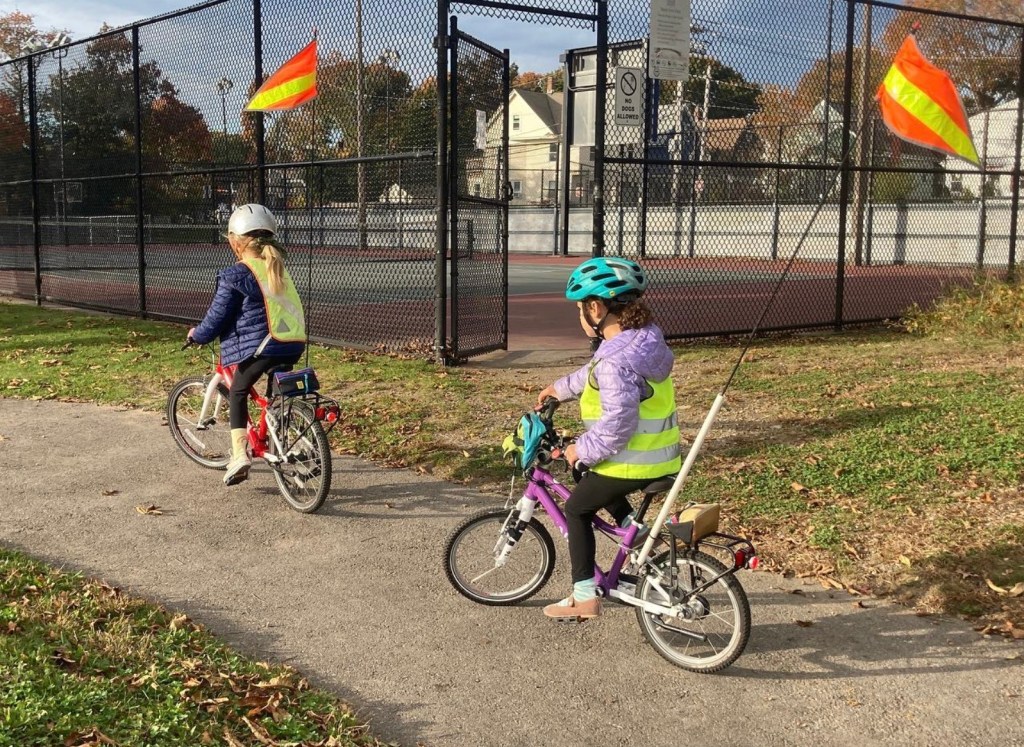
My biggest concern for them riding on the sidewalk is drivers not seeing them when they back out of the driveway. Kids on bikes are short, so I use 6ft flags to raise their visibility. I personally think that a flag is an essential piece of bike safety gear, but it’s very rare to see kids with bike flag.
Perhaps part of the reason is that the flag hunt turned out to be more frustrating than I would have thought. Basic bike flags like the one picture below were too cheap to be useful.
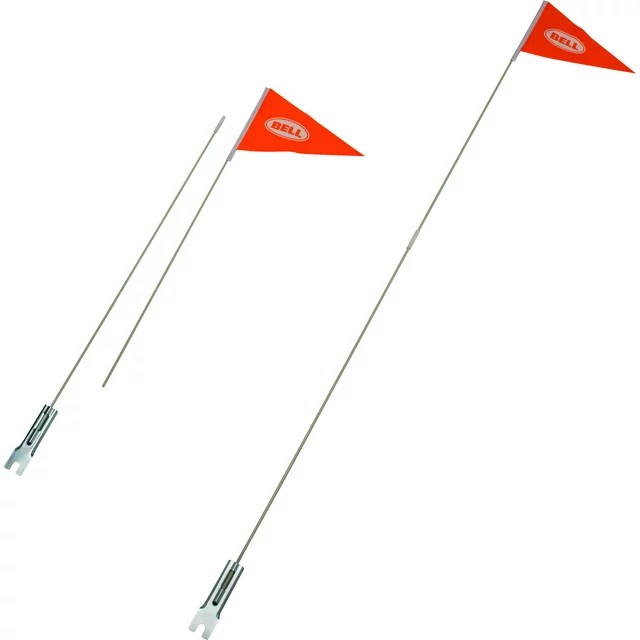
The flag itself was fine, but the bracket did not hold up!
It turns out there’s no a big market for hearty bike flag brackets (go figure!). I ended up using this one, which works wonderfully (but is a more expensive than feels necessary). I coupled the bracket with the original flags that I had bought for the kids with the cheaper brackets.
The flag saga doesn’t end there. I quickly learned that flags on the kids bikes were VERY wobbly. I added rear racks to their bikes. For a 20″ bike I zip-tied the flag to the rack. On the 16″ bike, even with zip ties, the flag was still too wobbly. I added a piece of PVC pipe to make the base more stable. See the top photo in this post to see it in action.
The flags not only make kids on short bikes more visible to cars, they’re also much more visible to me! It’s a lot easier to see them when we’re out and about by tracking their flag, especially if we go to pedestrian-heavy places like the Esplanade on a warm weekend afternoon.
Lights & Vests
I follow similar strategies to those I outlined in this post about nightttime visibility. My kids use front and rear lights day or night. They rarely bike at night so I have their lights set to blinking for daytime riding.
They also both wear reflective vests whenever we head out. We store these in bike trunks that we keep on their rear racks (along with their bike locks).
Biking Strategies
Once you have the necessary gear, it’s important to think about the rules of the sidewalk that you want to impart on your children.
- Awareness of Driveways: My kids generally know to be aware of cars in the driveway, especially if they are on an idling. I emphasize that they should listen for the sounds of the motor and look for rear lights (red and/or white) in the back.
- Stop and Wait: On our routes, we have stopping points where the kids will wait for me. This is trickier to do if you’re going to new places, but on your usual routes to the park, library or school, it’s fairly easy to get into a routine. My children generally don’t have a problem hanging out until I catch up (which can take a minute or two), but I imagine some kids might find that boring.
We stop at intersections, entrances to parking lots, and before blind turns. After I meet them I at a checkpoint, I will say, “Ok, see you next at the yellow pole,” (or whatever the next check point may be). Even though we’ve done this route for a couple of years, I continue to remind them of when I’ll see them next.
One issue you may run into is that while kids are waiting at a crosswalk, a car will stop to let them cross. I’ve taught my kids to wave the cars through to help prevent confusion. I also ask them not to wait very close to the intersection (waiting 10 feet back at a stop gives a clear indication that they’re not trying to cross), but they have a hard time remembering to do this. - Crosswalks: We either go through crosswalks together, or I go first, make sure traffic is stopped, and then wave them through. I’m also training them to have some situational awareness if it’s safe to cross. I ask them if it’s safe and then after there answer I’ll say ‘I agree/disagree’ and then we either wait or go.
- Narrate what you see: My kids may find this obnoxious, but I often think aloud when we bike. For example, there are some intersections on our route where cars routinely make illegal rights on red or blow through the light/stop sign altogether. I will say, “Ok, we have the walk sign but I’m going to wait and make sure that this white car stops before I cross.”
One last note — with the increased use of balance bikes, kids are physically ready for pedals at earlier ages. Before transitioning your kid to a pedal bike, be sure that they’re mentally ready to handle the safety rules for riding on the sidewalk. Though a 3 year old maybe ready to advance to pedals, can they be trusted to stop at meeting points, to watch for driveways, or reliable stop before an intersection? Be sure to take that into consideration before transitioning off a balance bike.
I made a reel highlighting most of the safety tips outline in this post. What strategies does your family use when the kids bike and their caregivers walks? Riding your bike to school is a great way to start the day!



 Cargo Bike Chronicles
Leave a reply to I Just Bought a Longtail Cargo Bike — Now What? – Cargo Bike Chronicles Cancel reply