In celebration of daylight savings returning, how about an (un)timely post on nighttime visibility?
In Boston, dusk hits around 4pm in December. It’s dark and gloomy here — but you can still be seen when the (sun)light goes out. Here are the strategies I’ve used to help drivers see me — tips include integrated and added traditional bike lights, reflective gear, and how to use a variety or products to illuminate the passenger area of your bicycle.
Bike Lights
E-assist bikes generally come with integrated lighting. This is great! You never have to worry about running lights. If your e-bike is running, your lights are running. Often if you run out of juice to run the pedal assist, the lights will stay on for a bit longer. I keep the integrated lights on, day and night.
I’ve generally found that the stock lights were too weak to help me see things in dark environments. In the city, there are almost always street lights, but for a few years I needed to bike through the Arnold Arboretum after dark (no street lights in there) and I needed additional lighting to be able to see where I was going.
For the trike, I upgraded the stock lights to a set that were much more powerful. The Urban Arrow’s stock light is plenty powerful, and I use a helmet light. For the longtail, I added a rechargeable light and hooked it up on the handlebars (I also updated the stock light that had a high beam function).
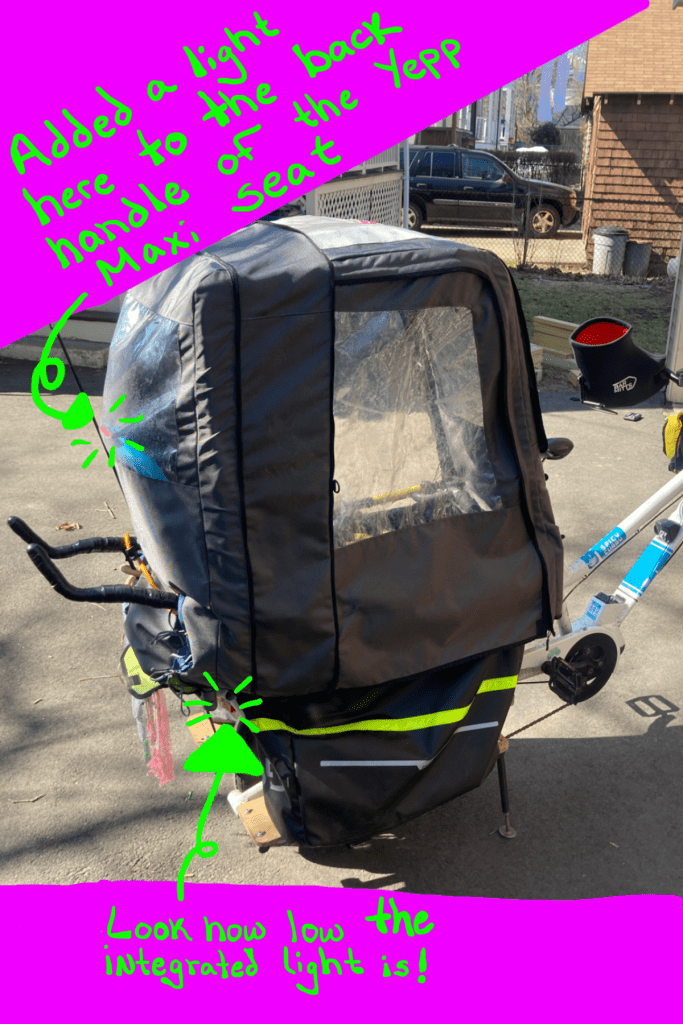
Even if your bike does have integrated lighting you may want to consider upgrading the stock lights or carrying additional lights. I think, at minimum, everyone should have an additional rear light. Cargo bike rear lights, in particular, tend to be lower down on the frame (especially if you ride a mid or longtail with a 20″ rear wheel) and can be harder to see in the midst of accessories (like box covers and other items used to keep kids warm and protected in the winter months).
I ride with a front and rear light on my helmet that I set to blink (daytime) and steady (night). I will not recommend my current bike light because it doesn’t save settings and going through the cycles to get what I want is a pain. This is the one I had before and I liked it a lot.
When looking for a bike light, consider how easy it will be to turn on/change settings when it’s mounted on your head. My current light requires touch pattern to trigger the front or rear light. This is difficult to do in practice. My first light had a sequence for each push (e.g., first push was front, second push was back, third push was both). This is much easier to set when the helmet and light are on your head.
Neon & Reflective Gear
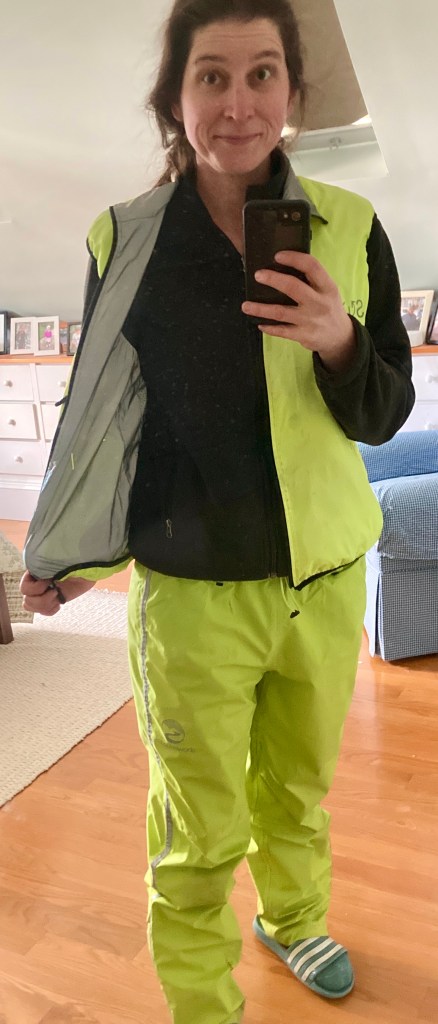
In the winter I wear neon pants, always. Not only are they nice and flashy, but I consider them essential for riding in the winter. They cut the wind and no matter the temp, I feel pretty comfortable when I wear these over whatever pants I’ve chosen for the day. Much to my family’s chagrin, when we do any cold-weather outings I like to wear my neon pants.
I know that they’re not the most fashionable, but, neither am I. This is my second pair and the ones I’ve linked don’t have pockets (which I really miss), but they’re a bit cheaper than my original pair. I do prefer the elastic waistband in this version as they’re more comfortable over whatever pants I’m wearing that day.
I love this vest — it has a chest pocket on both sides and the reflective visibility at night is amazing. The only thing I don’t like is that the black band at the bottom absorbs water in the rain which sometimes gets my clothing wet, but I don’t consider that to be a deal breaker.
My kids also wear neon vests whenever they ride their own bikes. If your kids are on a long tail you can consider having them where their vests while they’re riding on the back of the bike.
Reflective Stickers
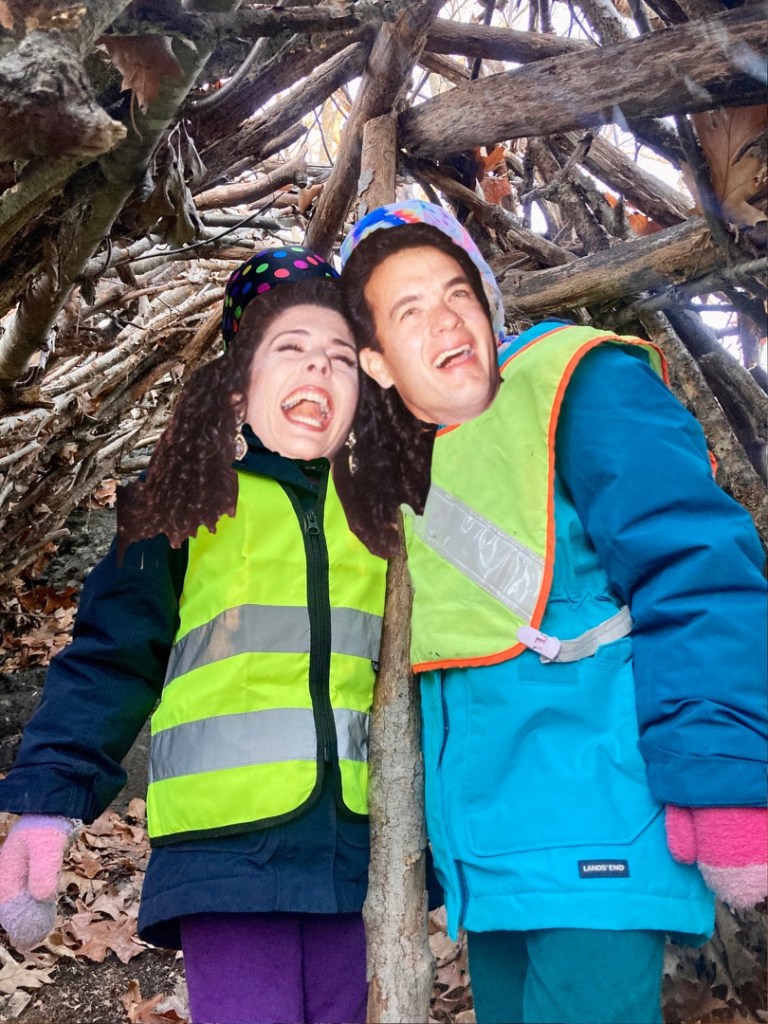
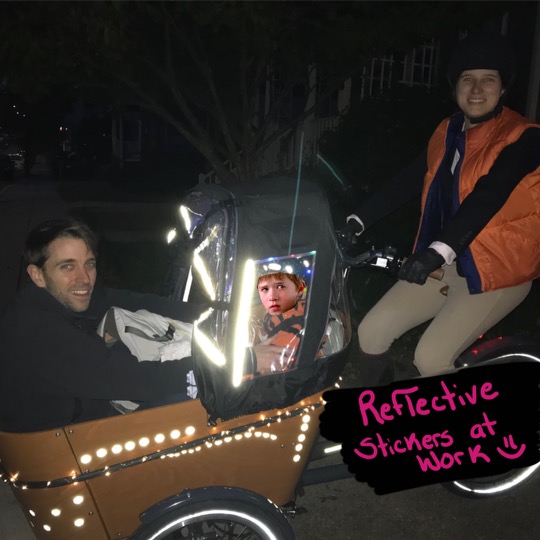
I’ve added reflective stickers to my bikes and helmets to help with 360° visibility. I linked the brand I used, but there are many, many options out there! A search on Etsy or international sellers will give you more options.
Light the Passengers
Lighting the box or rear rack has the benefit of both increasing visilibity and allowing the kids to do activities should they choose (we usually do library runs in the winter after school and my kids can look at their books on the way home).
I’ve done a few different systems with my different bikes. With the trike I used AA battery operated twinkle lights. The battery charge typically lasted all winter. I found that one standard size old bike tube could be stretched around the box, and then I wrapped the lights around the tube. I hung the battery packs with zipties to the frame of the rain canopy.

On the long tail I wrapped lights around the support frame for the Yuba Pop Top. I also wrapped them around the bread basket (front rack) too.
If I were outfitting either bike now I’d like go with travel canister lights which I would have clipped to the frame of the rain tent. I originally used these but they aren’t robust enough (though the battery life and light level were excellent). I’m going to try these (Black Diamond Moji R+ Lantern) next which someone in my Urban Arrow Facebook group recommended

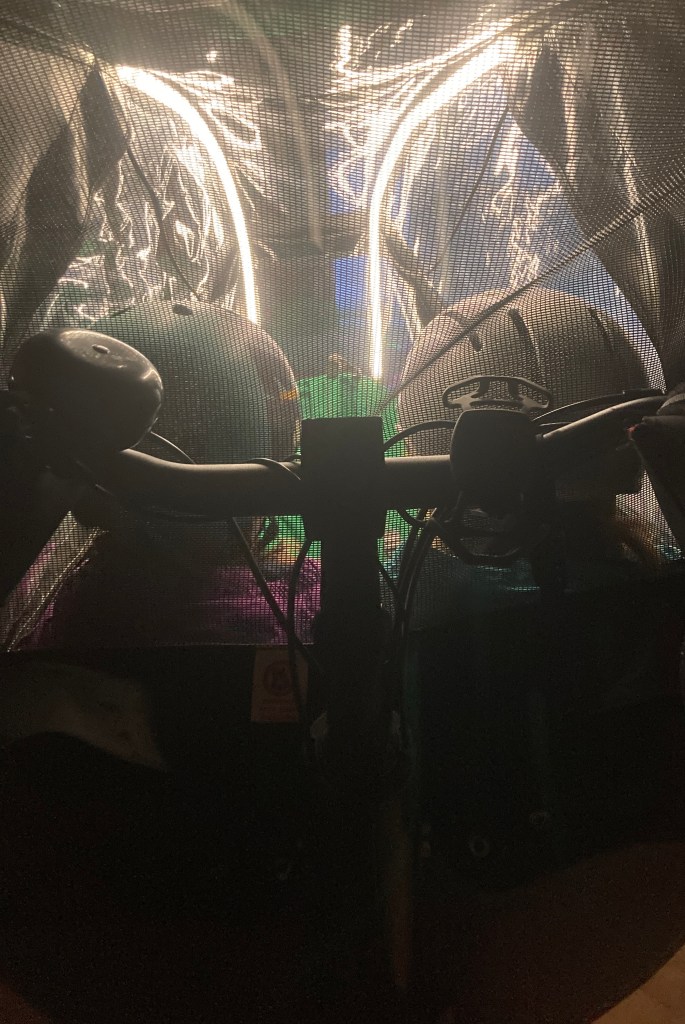
I bought the CargoGlow lights last year (seen above) and after a few months of use the wire frayed at the USB connection site and I needed to do a DIY repair. These are expensive to procure in the US, and because the company is in Germany, it was cost prohibitive to get them repaired/replaced professionally. I also think that the light is a little harsh on my eyes (though the kids never complain). For me, these weren’t worth the expensive for how long they lasted.
With this type of light you do need a power bank on board. I use a “solar” powered rechargeable battery (I’ve never successfully had the sun recharge it). I actually like carrying a battery onboard…it’s helped in times of “crisis” (aka, I need to charge my phone/kids’ music speaker/non integrated lights while we’re on the go). Obviously none of those qualify as a crisis, but I like having the battery! I keep the cords in a zip pocket in my trunk bag.
Lighting from Head to Toe
I’ve not used a helmet with integrated lighting (like Lumos), but they look great, and I’ve heard good things! I also had someone highly recommend these pedal lights while we were both waiting at a red light. I’m also interested in the Lumos Firefy lights which operate as lights and turn signals. Iff you have experience with these, or other lighting/visibility solutions, please comment below.
Light up your bike both during the day and at night. There are many options at many price points, and I hope this was a good intro to the different options and creative ways to illuminate your unique bike.



 Cargo Bike Chronicles
Leave a reply to I Just Bought a Longtail Cargo Bike — Now What? – Cargo Bike Chronicles Cancel reply